
Nitrogen for Air Conditioning
Showing all 4 resultsSorted by popularity
More about Nitrogen for Air Conditioning
Why Air Conditioning and Refrigeration Engineers Use Oxygen-Free Nitrogen
What is oxygen-free nitrogen and why does AC work need it?
Nitrogen for air conditioning work means one specific product: oxygen free nitrogen, usually shortened to OFN. It's an inert, dry gas that won't react with copper pipework, won't support combustion, and carries none of the moisture that ordinary compressed air does. That combination makes it the standard gas for installing and servicing split systems, heat pumps, and refrigeration circuits.
Air and moisture are the two things a refrigeration circuit can't tolerate. Air introduces oxygen, which oxidises copper pipe from the inside during brazing and leaves flaky scale that can travel through the system and block expansion valves or filter driers. Moisture turns to ice at the metering device and corrodes components over time. OFN displaces both, which is why it's used at several distinct stages of an installation: pressure testing new pipework for leaks, purging lines before and during brazing, and clearing the system of air prior to evacuation and refrigerant charging.
None of this is optional on a professional job. Manufacturers' installation instructions and industry guidance for AC and refrigeration work specify nitrogen for these steps, and it's cheap insurance against a comeback callout for a leak that a few minutes of pressure testing would have caught. See our nitrogen for air conditioning range for the cylinder sizes and regulator stocked for this exact purpose.
Pressure Testing and Pipe Purging Explained
Pressure testing and nitrogen for pipe purging
Once pipework is run and joints are brazed, the circuit needs to be proven tight before it's evacuated and charged with refrigerant. That's done by connecting a cylinder of OFN through a suitable regulator and gauge set, filling the system to a stable pressure, and leaving it to sit. If the pressure holds, the joints are sound. If it drops, there's a leak to find and re-work before moving on — far cheaper to catch at this stage than after the system is charged and running. We don't quote specific test pressures here, since the correct figure depends on the equipment manufacturer's instructions and the components fitted, but the principle is the same across almost every domestic and commercial split system.
Nitrogen for pipe purging is a related but separate step. Rather than pressurising a sealed system, a light, continuous flow of OFN is passed through the pipework while it's open — most commonly during brazing, but also afterwards to clear residual air and moisture before the vacuum stage. Purging keeps the inside of the pipe free of the atmosphere, which matters because copper reacts with the oxygen in ordinary air the moment it's heated.
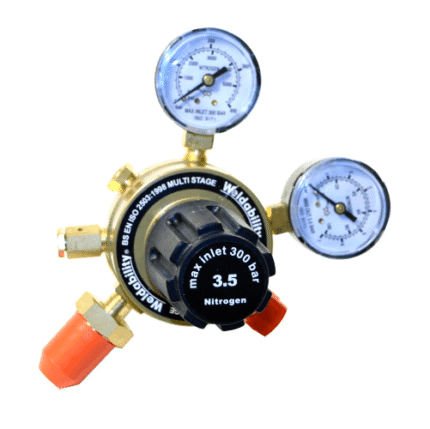
Both jobs need a regulator that can control flow precisely rather than just deliver full cylinder pressure — too much flow at the wrong moment can blow a joint apart before it's set, too little won't clear the pipe properly. A single-stage, two-gauge regulator rated to at least 300 bar inlet with a usable flow range up to around 10 lpm, like the one we stock, covers both testing and purging duties on the same setup.
Brazing Under Nitrogen
Brazing copper joints under a nitrogen purge
Brazing is where oxygen-free nitrogen earns its keep most visibly. When a copper joint is heated with a torch in ordinary air, the oxygen inside the pipe reacts with the hot copper and forms a layer of black oxide scale on the internal wall. That scale doesn't stay put — it breaks away once refrigerant starts circulating and migrates through the system, where it can contaminate the compressor oil, coat the inside of the expansion valve, or block the fine mesh of a filter drier. Any of those outcomes means a return visit, and sometimes a full recovery, flush, and recharge.
Purging the pipework with a slow, steady flow of nitrogen while each joint is brazed solves this by keeping oxygen away from the hot metal for the duration of the braze. The flow needs to be gentle enough not to disturb the flame or cool the joint below brazing temperature, but continuous enough to keep displacing air as it's drawn back in. Engineers typically feed nitrogen in at one end of the circuit with the far end left slightly open, so the gas has somewhere to go rather than building pressure while the joint is still molten.
This is standard practice on commercial and larger domestic installations, and increasingly expected on any brazed joint regardless of system size — it's a small extra step for a joint that will otherwise be hidden inside a wall or ceiling void for the next fifteen years.
Choosing Your Cylinder Size, Regulator and Ordering
Choosing a nitrogen cylinder size and regulator
Our oxygen-free nitrogen is sold outright — there's no rental agreement or cylinder deposit to manage, so you own the bottle from the moment it arrives and can keep it on the van or in the workshop for as long as it's useful.
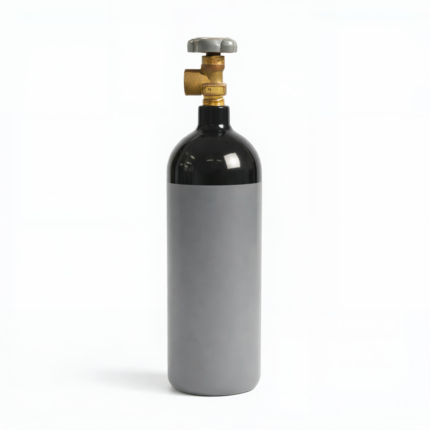
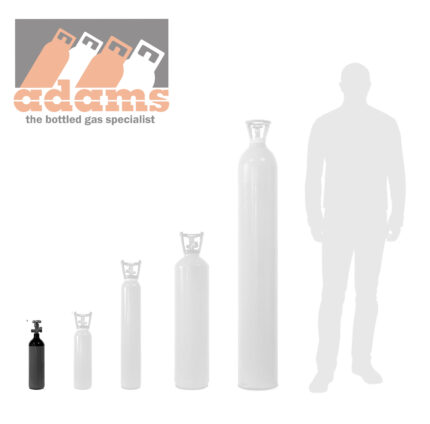
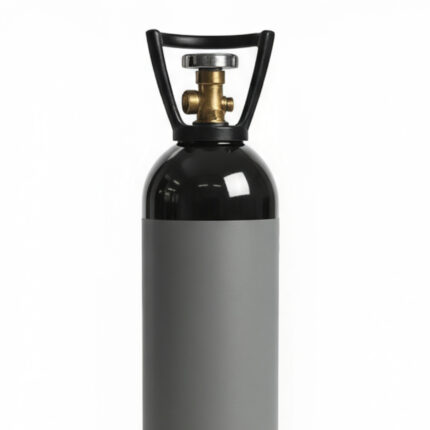
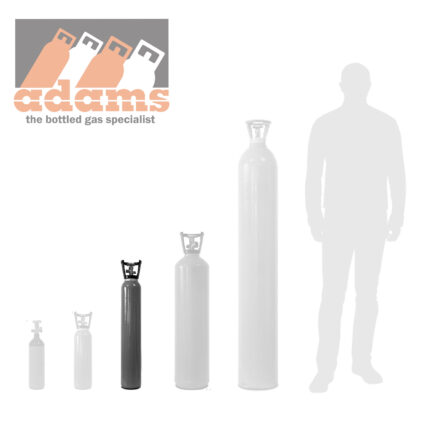
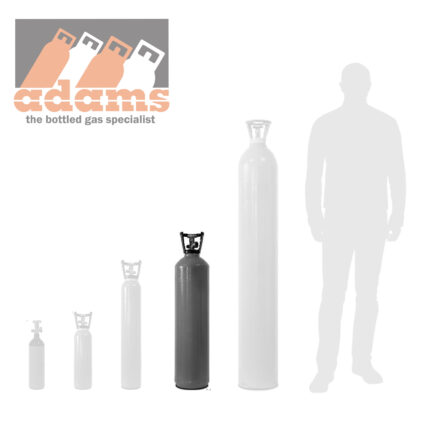
Three sizes are stocked to match the scale of the job. The 2L (200 bar) at £28.09 is the practical choice for a single split-system install or a service call where you need a bottle that fits in the van without taking up a lot of space. The 9.4L (137 bar) at £43.88 sits in the middle and suits engineers doing a run of smaller jobs between refills. The 20L (200 bar) at £75.94 holds the most gas per fill and is the better choice for commercial installations, multi-circuit systems, or anyone purging and pressure testing several systems in a day.
Whichever size you choose, you'll need a regulator to use it safely — cylinder pressure on its own is far too high to feed directly into pipework. Our nitrogen regulator is a single-stage, two-gauge unit rated to 300 bar inlet with flow up to 10 lpm, priced at £45.90, and gives you both the inlet and outlet pressure readings needed for accurate pressure testing and controlled purge flow during brazing.
Browse the full range, including current stock and delivery options, on our nitrogen for air conditioning category page. If you're new to bottled gas or want a wider overview of cylinder types and sizes across our range, our bottled gas guide is a useful starting point.
Online store of household appliances and electronics
Then the question arises: where’s the content? Not there yet? That’s not so bad, there’s dummy copy to the rescue. But worse, what if the fish doesn’t fit in the can, the foot’s to big for the boot? Or to small? To short sentences, to many headings, images too large for the proposed design, or too small, or they fit in but it looks iffy for reasons.
A client that’s unhappy for a reason is a problem, a client that’s unhappy though he or her can’t quite put a finger on it is worse. Chances are there wasn’t collaboration, communication, and checkpoints, there wasn’t a process agreed upon or specified with the granularity required. It’s content strategy gone awry right from the start. If that’s what you think how bout the other way around? How can you evaluate content without design? No typography, no colors, no layout, no styles, all those things that convey the important signals that go beyond the mere textual, hierarchies of information, weight, emphasis, oblique stresses, priorities, all those subtle cues that also have visual and emotional appeal to the reader.
