Blog
MIG Gas Bottle Comparison: Argon Vs CO2 – Which Is Better For Your Welding Project?

Have you ever stood in front of your welder, torch in hand, and stared at the gas regulator wondering if you’ve actually got the right stuff in the tank? Whether you’re a hobbyist fixing up a classic Mini in the garage or a professional fabricator working on structural steel, the "Argon vs. CO2" debate is one that pops up constantly.
Does it really matter which gas you use? Is the cheaper option always a false economy? At Bottle Gases, we see customers grappling with these questions every day. Choosing the right shielding gas isn’t just a technical box to tick; it’s the difference between a weld that looks like a row of dimes and one that looks like a bird’s breakfast.
In this guide, we’re going to break down the differences between Pure Argon, Pure CO2, and the popular Argon/CO2 mixes. We’ll look at the costs, the finishes, and most importantly, which one is going to make your life easier.
Why Do We Need Shielding Gas Anyway?
Before we dive into the comparison, let’s quickly remind ourselves why we’re even using gas for MIG welding.
Think of shielding gas as a protective invisible bubble. When you strike an arc, the molten metal is incredibly vulnerable. If oxygen, nitrogen, or hydrogen from the air gets into that weld pool, you’re in trouble. You’ll end up with porosity (tiny holes that look like a sponge), brittleness, and a weld that could fail under pressure.
Choosing between Argon and CO2 is essentially choosing how you want that "bubble" to behave. It affects how deep the weld goes, how much "spatter" (those annoying little molten blobs) flies off, and how smooth the final bead looks.
Pure CO2: The Budget-Friendly Workhorse
If you’re looking at the bottom line, Pure CO2 is usually the cheapest option on the market. In the UK, many DIYers start with CO2 because it’s accessible and gets the job done on a budget. You can find various sizes, from small CO2 bottles for portable jobs to larger cylinders for the workshop.
The Pros of CO2
- Deep Penetration: CO2 is excellent for thick structural steel. It provides a very "hot" arc that digs deep into the metal.
- Lower Cost: Per Liter, CO2 is significantly cheaper than Argon.
- Availability: It’s a very common gas used in everything from beer and cellar systems to fire extinguishers.
The Cons of CO2
- The Spatter Factor: This is the big one. Pure CO2 creates a lot of spatter. You’ll spend significantly more time with a grinder or a chisel cleaning up the mess around your weld.
- A "Harsh" Arc: The arc isn't as stable as an Argon mix. It can feel a bit "violent" and harder to control, especially on thinner materials.
- Limited Versatility: You can really only use it on carbon steel. Try it on aluminium, and you’ll have a disaster on your hands.
Pure Argon: The Specialist’s Choice
Pure Argon is an "inert" gas, meaning it doesn't react with anything. While it’s the king of TIG welding, its role in MIG welding is much more specific.
If you are working with non-ferrous metals like aluminium, magnesium, or titanium, Pure Argon is your only real choice. Because these metals are highly reactive, they need the total protection that only a 99.9% pure inert gas can provide. We offer several options for this, including our Pure Argon 2L refill for smaller repairs or the 10L Pure Argon cylinder for more involved projects.
When to use Pure Argon:
- Aluminium Welding: Essential for a clean, soot-free weld.
- Thinner Materials: It provides a very stable, narrow arc.
- TIG Applications: If you’re switching between MIG and TIG, you’ll likely need a bottle of pure Argon anyway.
The downside? On standard carbon steel, Pure Argon actually performs quite poorly. It doesn’t provide enough "wetting" action, leading to a weld bead that sits tall on the surface rather than blending in, often resulting in poor penetration.
The "Goldilocks" Solution: Argon/CO2 Mixes
For 90% of the welding done in the UK, a mix of Argon and CO2 is the "just right" solution. These mixes take the best parts of both gases: the arc stability and low spatter of Argon, combined with the penetration power of CO2.
At Bottle Gases, our most popular choice for general steelwork is the 5% CO2 / Argon mix. This is specifically designed for welding steel up to a thickness of 6mm.
Why a Mix is Usually Better:
- Cleaner Finishes: You get far less spatter than pure CO2, which means less time grinding and more time welding.
- Better Bead Profile: The weld flows better, giving you a flatter, more professional-looking finish.
- Ease of Use: It makes the machine feel "smoother." If you’re a beginner, a 5% or 10% mix will make you look like a pro much faster than pure CO2 will.
For home hobbyists or mobile welders, a 2L Argon/CO2 mix bottle is a great way to get professional results without lugging a massive tank around. If you're doing a full car restoration or building a gate, the 20L Argon/CO2 mix is much more cost-effective.
Comparing the Costs: Gas Price vs. Labour Time
When Steve, our Director, talks to customers about gas, he always emphasizes one thing: don't just look at the price of the bottle.
Imagine you're a DIYer named Dave. Dave buys a cheap bottle of CO2 to weld some patches onto a transit van. He saves £20 on the gas. However, because of the heavy spatter, Dave spends an extra three hours grinding and cleaning the metal so he can paint it.
If Dave values his time at even £10 an hour, he’s actually lost money by choosing the cheaper gas. This is why most professional shops use Argon mixes; the "hidden cost" of cleaning up after pure CO2 usually outweighs the savings on the gas itself.
The Bottle Gases Advantage: No Rental Fees
In the UK, many industrial gas suppliers charge a monthly rental fee for their cylinders. This is fine if you're a factory using ten bottles a day, but for a hobbyist or a small business, it’s a nightmare. You end up paying for the bottle to sit in your workshop doing nothing.
At Bottle Gases, we do things differently. We offer no recurring rental fees. You buy the gas, you use the gas, and when it’s empty, you simply pay for a refill. It’s like owning your car rather than leasing it: you have the freedom to use it whenever you want without a monthly bill hitting your letterbox.
Which Gas Bottle Size Do You Need?
Choosing the right size is just as important as choosing the right gas. You don't want to run out on a Sunday afternoon when you’re halfway through a job!
- 2 Litre (200 Bar): Perfect for small repairs, "on-the-go" maintenance, or if you only weld once or twice a year. Extremely portable.
- 10 Litre (200 Bar): The "sweet spot" for most hobbyists and serious DIYers. It’s heavy enough to last through a decent project but light enough to move around easily.
- 20 Litre (200 Bar): The best value for money. If you’re a regular welder or have a large project like a vehicle restoration, this is the way to go.
Remember, all our cylinders are filled to 200 Bar, meaning you get a lot of gas packed into a compact space.
Safety and Equipment: Don't Forget the Regulator!
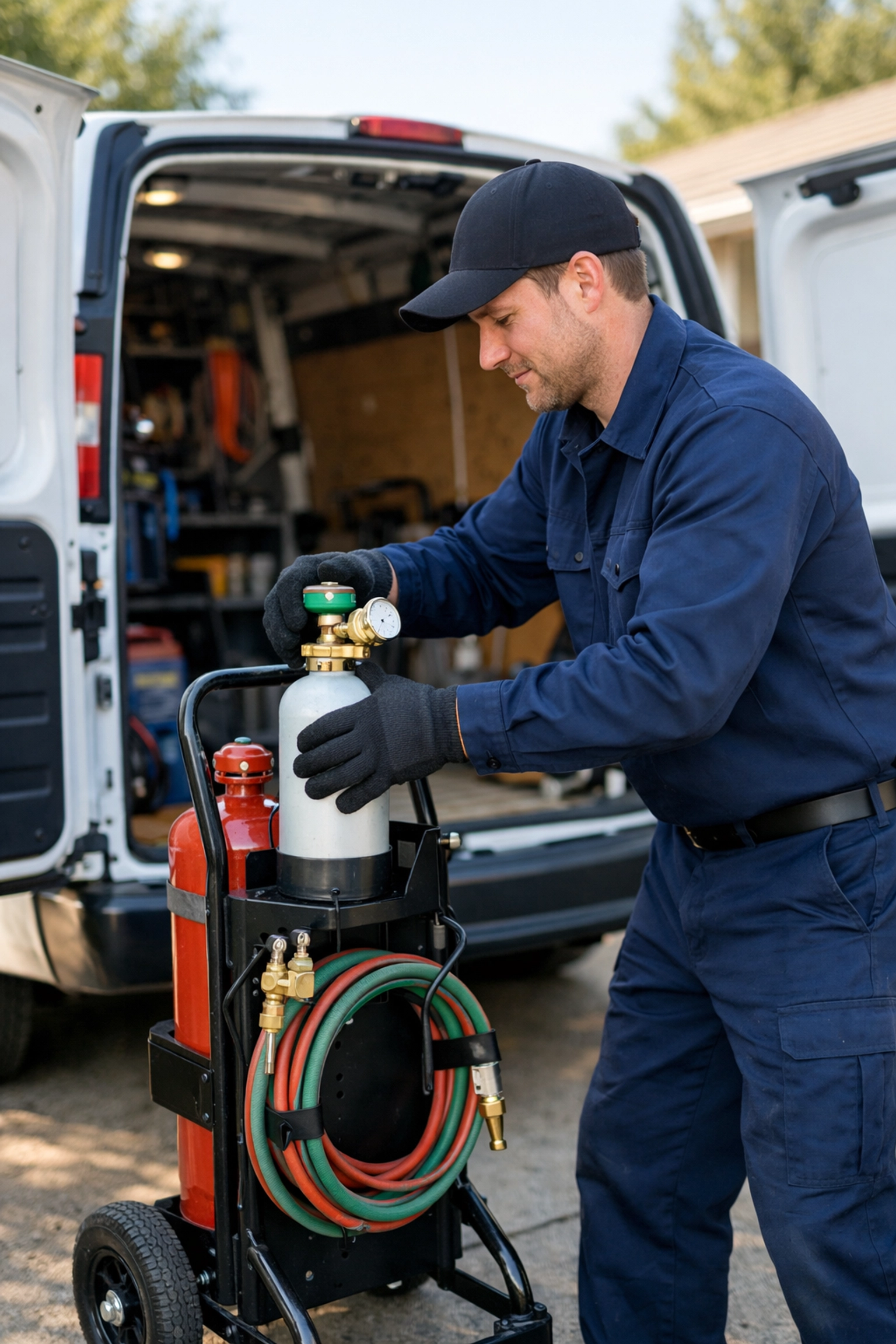
You can’t just hook a hose to these bottles and hope for the best. Because these cylinders are pressurized to 200 Bar, you need a high-quality regulator to bring that pressure down to a useable flow rate (usually around 10-15 Liters per minute for MIG).
If you’re moving from disposable canisters to refillable bottles, you will need a proper industrial regulator. We recommend a Single Stage Twin Gauge Argon Regulator. The twin gauges are a lifesaver: one shows you how much gas is left in the bottle, and the other shows your output flow rate. No more guessing when you’re about to run out!
For more on staying safe while you work, check out our Welding Gas Safety Guide.
Scenario: What Should You Choose?
To make it simple, let’s look at a few common scenarios:
- Scenario A: The Car Restorer. You’re welding thin sheet metal on a classic car.
- Recommendation: 5% Argon/CO2 Mix. It provides the cleanest weld with the least heat distortion and minimal spatter.
- Scenario B: The Garden Gate Builder. You’re welding 5mm thick box section steel for a new driveway gate.
- Recommendation: 5% Argon/CO2 Mix or Pure CO2. If you don't mind the cleanup, CO2 works, but the mix will give you a much prettier finish for your hard work.
- Scenario C: The Boat Repairer. You need to weld an aluminium bracket onto a hull.
- Recommendation: Pure Argon. Do not use a mix or pure CO2 here; it simply won’t work.
Summary: Making the Right Choice
Choosing between Argon and CO2 doesn't have to be a headache.
If you want the absolute cheapest option and don't mind a bit of extra work cleaning up spatter, Pure CO2 is your friend. If you are welding aluminium or doing precision TIG work, Pure Argon is the only way to go.
However, for almost everyone else welding steel in their workshop or garage, an Argon/CO2 mix is the gold standard. It offers the best balance of performance, ease of use, and final weld quality.
At Bottle Gases, we’re proud to offer nationwide delivery across the UK, competitive pricing, and our signature no rental fee model. Whether you need a tiny 2L Argon cylinder or a large 20L MIG mix, we’ve got you covered.
Ready to upgrade your welding game? Explore our full range of MIG welding gas bottles today and experience the difference that the right gas can make. Your grinder will thank you!
Argon vs CO2 for MIG welding: which is better?
For most hobby and light-fabrication MIG welding on mild steel, an argon/CO2 mix — typically 80/20 — gives the cleanest, most controllable weld and is the best all-round choice. Pure CO2 is cheaper and penetrates deeper but spatters more, while pure argon is for aluminium and non-ferrous metals, not mild steel.
Last updated: July 2026. Written by the Bottle Gases team.
The gas flowing through your torch is a shielding gas: it pushes air away from the molten weld pool so the weld does not oxidise and go porous. The blend you choose changes how the arc behaves, how deep it fuses, how much spatter you clean up afterwards, and how much the bottle costs to run. Here is how the common options compare at a glance.
Argon vs CO2 MIG gas comparison table
| Shielding gas | Best for | Weld quality | Spatter | Penetration | Relative cost |
|---|---|---|---|---|---|
| 100% CO2 | Thick mild steel on a budget | Rougher bead | High | Deepest | Lowest |
| 5% CO2 / 95% argon | Thin sheet and car panels | Very clean | Very low | Shallow | Higher |
| 12% CO2 / 88% argon | General fabrication | Clean and stable | Low | Moderate | Mid |
| 20% CO2 / 80% argon (80/20) | All-round mild steel | Clean, easy to control | Low | Good | Mid |
| 100% argon | Aluminium and non-ferrous only | Excellent on aluminium | Very low | Poor on steel | Highest |
The pattern is simple: more CO2 means deeper penetration and more spatter; more argon means a smoother, cleaner, more stable arc. That is why an 80/20 mix is the default for mild steel — it keeps most of argon’s smoothness while the 20% CO2 gives the fusion steel needs.
Which gas mix for which steel thickness
Match the mix to the metal. A leaner (lower CO2) mix suits thin material because it puts less heat in and warps the panel less; a richer mix or pure CO2 is better on thicker sections that need deeper fusion.
| Mild steel thickness | Recommended mix | Why |
|---|---|---|
| Thin sheet, roughly 0.8–3 mm | 5% CO2 mix | Minimal distortion and spatter on panels and light sheet |
| General work, roughly 3–6 mm | 12% CO2 mix | Balanced penetration with a clean, controllable finish |
| Heavier steel, roughly 6–14 mm | 20% CO2 mix (80/20) | Deeper penetration for structural and thicker sections |
| Very thick or deep-fusion work | 100% CO2 | Deepest fusion and lowest cost, at the price of more spatter |
Our MIG welding gas range carries the 5%, 12% and 20% argon/CO2 mixes for steel from around 4 mm up to 14 mm, plus pure CO2 and pure argon for aluminium.
Can you MIG weld mild steel with pure argon?
No. Pure argon does not carry enough energy into steel, so the arc wanders, penetration is poor and the bead sits on top rather than fusing in. Steel needs the CO2 content of a mix (or 100% CO2). Save pure argon for aluminium and other non-ferrous metals, where it is exactly the right choice.
Is argon gas expensive? MIG gas running costs
Argon is the pricier ingredient, so cost climbs as you add more of it: pure CO2 is the cheapest bottle to run, the argon/CO2 mixes sit in the middle, and pure argon is the most expensive of the three. Cylinder size matters too — a larger bottle costs more up front but works out cheaper per weld.
Look past the sticker price, though. A slightly dearer mix that cuts spatter saves you time, grinding discs and rework, so it can be cheaper on the finished job than the “budget” option. And because every Bottle Gases cylinder is rent-free — you own the bottle and pay only for the gas plus a refundable deposit — there are no rental fees or standing charges quietly inflating your running cost. Current prices for each mix and size are shown on the MIG welding gas product pages.