Cart 0

The Ultimate Guide to Nitrogen for Air Conditioning: Why HVAC Pros Choose OFN
Ever spent a freezing Tuesday morning chasing a microscopic leak in a multi-split system, wishing you’d just done a proper pressure test from the start? Or perhaps you’ve cut into a failed compressor only to find it choked with black soot from a brazing job gone wrong? If you’ve been in the HVAC trade for more than a week, you know these aren't just minor inconveniences: they are profit-killers.
In the world of air conditioning and refrigeration, moisture and oxygen are the ultimate enemies. That is precisely why Oxygen-Free Nitrogen (OFN) is the go-to tool for every serious engineer in the UK. But why exactly is nitrogen the industry standard, and how can you make sure you’re getting the best value for your gas without getting stung by those "standard" industry rental fees?
Let’s dive into the world of OFN and see how it keeps your systems running cold and your business running in the black.
What Exactly is OFN, and Why Do You Need It?
Have you ever wondered why we can't just use a standard air compressor to pressure test a line? It’s a tempting thought, especially when you’re lugging gear up a ladder. But standard atmospheric air is packed with moisture and oxygen. When you’re dealing with modern refrigerants and the polyolester (POE) oils used in today’s compressors, moisture is a death sentence.
Oxygen-Free Nitrogen is exactly what it says on the tin: nitrogen gas that has had virtually all oxygen and moisture stripped away. It is an inert gas, meaning it doesn't react with the components of your AC system.
Think of using OFN like using a clean microfibre cloth on a high-end car, versus using a gritty old sponge. Both might "wipe" the surface, but only one leaves it pristine and ready for performance. When you purge a system with OFN, you’re creating a bone-dry, chemically stable environment that protects the integrity of the refrigerant you’re about to charge.
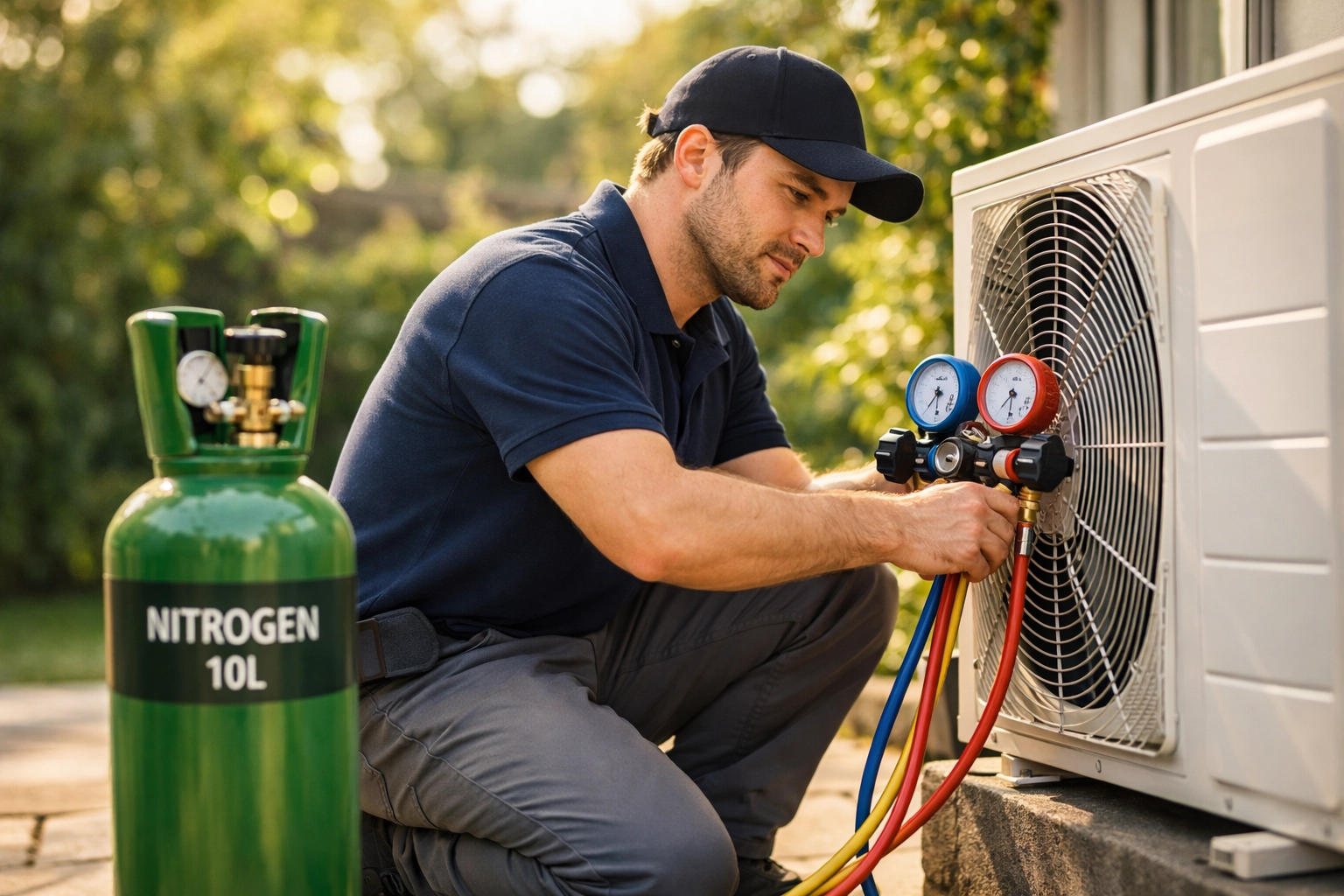
The Three Pillars of Nitrogen in HVAC
If you’re an HVAC pro, you aren't just buying a bottle of gas; you’re buying insurance for your reputation. There are three main scenarios where OFN earns its keep on the job site.
1. The Purge: Keeping the "Black Death" at Bay
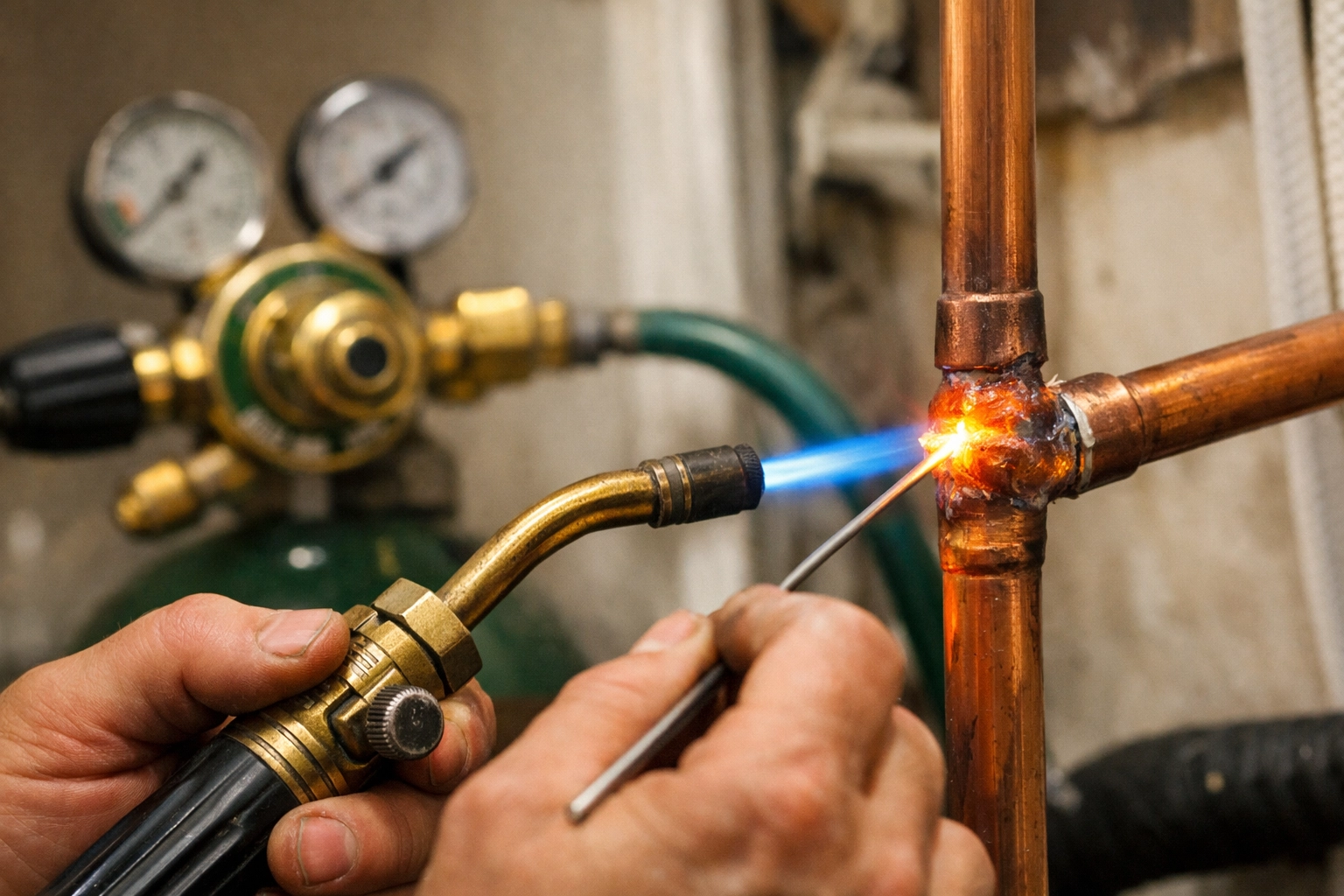
When you’re brazing copper pipework, the heat from your torch reacts with the oxygen inside the pipe. This creates cupric oxide: those nasty black flakes that look like soot. Once the system is running, those flakes travel through the lines, clogging expansion valves and eventually killing the compressor.
By flowing a small amount of Nitrogen through the pipe while you braze (usually at about 0.1 to 0.2 bar), you displace the oxygen. No oxygen means no oxidation. It’s a simple step that separates the "cowboys" from the professionals. Whether you're working on a small domestic unit or a massive VRF system, a nitrogen purge is non-negotiable.
2. Pressure Testing: Finding the Needle in the Haystack
We’ve all been there: a system that passes a vacuum test but loses its charge two weeks later. Vacuum tests are great for finding big leaks, but they can actually pull seals "shut," hiding small leaks.
Pressure testing with Nitrogen is the only way to be 100% sure. By pressurising the system (often up to 40 bar depending on the equipment specs), you’re stressing the joints from the inside out. If there’s a weak flare or a pinhole leak in a weld, the Nitrogen will find it.
3. Moisture Removal (Triple Evacuation)
Sometimes, a system gets "wet": maybe it was left open to the atmosphere or had a major leak. Removing that moisture is tough. By using Nitrogen to "sweep" the system between vacuum pulls (the triple evacuation method), the dry nitrogen absorbs the moisture, making it much easier for your vacuum pump to pull it out.
Why HVAC Pros are Moving Away from Gas Rental Fees
Let’s talk about the elephant in the room: the cost of the bottle. For years, the big industrial gas companies have tied HVAC engineers into complex rental contracts. You pay for the gas, sure, but you also pay a daily or monthly "rent" for the cylinder itself.
It’s a bit like renting a car but still having to pay for every mile and the petrol. If you have a slow month or the bottle sits in the back of the van for three weeks, you’re still bleeding money.
At Bottle Gases, we do things differently. We believe in competitive pricing with no recurring rental fees. You buy the bottle once, and when it’s empty, you simply pay for a refill. It’s yours. No monthly direct debits, no "lost bottle" fines, and no paperwork headaches. For a small business or an independent contractor, this can save hundreds of pounds a year.
Whether you need a compact 10-liter bottle for quick domestic repairs or a larger 20-liter cylinder for big commercial installs, owning your gas is the smartest financial move you can make.
Choosing the Right Size: Liters vs. Mobility
How much Nitrogen do you actually need? It’s a balancing act between having enough gas to finish the job and not breaking your back carrying it.
- 10-Liter Cylinders (approx. 2.0m³ of gas): These are the gold standard for most service engineers. They are portable enough to carry up a ladder or into a loft space, yet they hold enough gas for several brazing purges or a solid pressure test on a standard split system.
- 20-Liter Cylinders (approx. 4.0m³ of gas): If you’re commissioning a large commercial VRF system with hundreds of meters of pipework, the 20L is your best friend. It gives you the volume needed to pressurise large systems to 40 bar without constantly worrying about the gauge hitting red.
Regardless of the size, all our cylinders are filled to a high pressure (typically 200 bar), ensuring you get the maximum amount of "work" out of every liter of bottle space. And because we offer nationwide delivery, you don't have to waste half a day driving to a collection point. We bring the gas to your workshop or your site.
More Than Just Nitrogen: A One-Stop Shop
While Nitrogen is the lifeblood of the AC tech, we know your work often overlaps with other trades. Maybe you’re doing a bit of bracket fabrication and need MIG welding gas, or perhaps you’re setting up a cellar cooling system and need CO2 or cellar gas.
We even cater to the "after-work" crowd. If you’re heading from a job to a weekend BBQ, we’ve got your LPG and Calor Gas needs covered too. Having one supplier who understands the UK trade market: from Helium for party planners to high-purity Nitrogen for labs: makes life a lot simpler.

Safety First: Handling High-Pressure OFN
We wouldn't be doing our job if we didn't mention safety. Nitrogen is an "asphyxiant." Because it has no smell and no colour, it can displace oxygen in a confined space (like a small plant room or a van) without you noticing.
Always ensure:
- Ventilation: Never release large amounts of Nitrogen in a sealed room.
- Regulators: Always use a high-quality Nitrogen regulator. Never, ever connect a cylinder directly to a system without one. A 200-bar cylinder will make short work of a 40-bar evaporator coil if things go wrong. Check out our gas regulators and equipment to ensure your kit is up to spec.
- Securing Bottles: Whether in the van or on-site, keep your cylinders upright and secured. A 10L bottle might be small, but at 200 bar, it’s a lot of stored energy.
The Future of Your Gas Supply
The HVAC industry in the UK is changing. With the phase-down of high-GWP refrigerants and the rise of heat pumps, the pressure to deliver high-quality, leak-free installations has never been higher. Using Oxygen-Free Nitrogen isn't just a recommendation anymore; it’s a requirement for F-Gas compliance and manufacturer warranties.
By switching to a rent-free model with Bottle Gases, you’re taking control of your overheads. You get the professional-grade gas you need, the nationwide delivery you want, and the peace of mind that you aren't paying for a bottle that’s just sitting in your garage during the winter months.
Ready to upgrade your kit? Whether you’re looking for Nitrogen cylinders for your next install or just want to browse our range of industrial gases, we’re here to help.
Don't let rental fees eat your margins. Choose the gas that works as hard as you do. Join the thousands of UK HVAC pros who have made the switch to Bottle Gases: where the gas is professional, the service is personal, and the rental fees are non-existent.
Explore our full range of Nitrogen solutions here and experience the difference of a truly local, nationwide gas supplier.